Then, in an instant, everything changed.
Out of nowhere, my father stormed toward us, screaming hateful words at the man—calling him a “filthy Jew”—before violently shoving him to the ground.
I was too young to understand the history behind the hatred. I had just witnessed, yet I understood something far more important: the Jewish man had shown me kindness, while hatred came from somewhere else entirely.
That moment never left me.
Years later, as a teenager, I watched Judgment at Nuremberg, my first film about the Holocaust. As the horrors unfolded on the screen, I was suddenly transported back to that day in Vienna.
The memory hit me with overwhelming force. For the first time, I began to understand the depth of suffering the Jewish people had endured. From that moment on, something awakened inside me. I became deeply curious about the Holocaust, about Israel, and about the Jewish people themselves.
In 1965, I visited the concentration camps at Dachau and Mauthausen. Walking through those grounds changed me. The silence there speaks in a way words never can. I could not comprehend how humanity could descend into such darkness.
Then came 1967 and the Six-Day War.
Watching Israel fight for survival against overwhelming odds stirred something profound in me. I found myself filled not only with admiration, but with love—love for the Jewish people and for the Land of Israel.
What captured me most was this: how could a people rise from the ashes of the Holocaust and, within barely twenty years, build one of the most remarkable nations on earth?
Instead of allowing tragedy to define them they chose courage, determination, innovation, and hope. They refused to become victims of their past.
That truth became deeply personal to me.
I grew up in an extremely abusive environment. The pain was so deep that at only six years old, I attempted to take my own life. Even as a child, I felt broken, rejected, and hopeless.
But somehow, through learning about the Jewish people, I found something unexpected: shared pain—but also shared strength.
Their story taught me that suffering does not have to define a person's destiny. Watching the Jewish people rebuild their lives, their homeland, and their identity after unimaginable horror planted something powerful inside of me.
I made a decision that I would never live as a victim. Like Israel, I would fight to become victorious over my past.
The Jewish people taught me that your history does not have to determine your future.
In 1967, I immigrated to Canada. Then in 1981, I accepted Yeshua as my Lord and Savior. As I began reading the Bible, my love for Israel deepened even more. Scripture opened my eyes to God's everlasting covenant with the Jewish people. His promises to Israel, and His faithfulness throughout history.
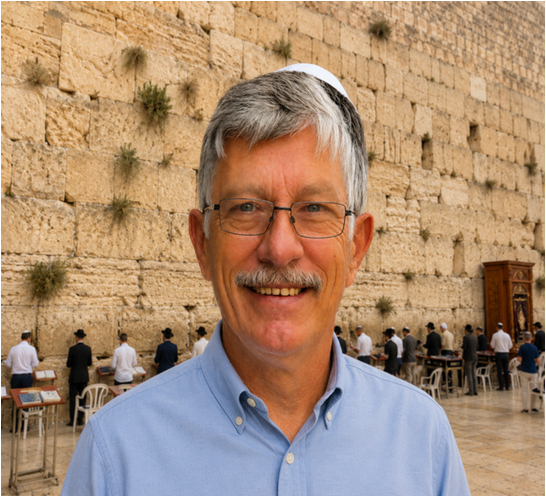
Then in 1982, I made my first journey to the land itself. That trip changed my life forever.
Israel was not simply another country to visit. From the moment I arrived, something inside me came alive.
For the first time in my life, the Bible became real. The places I had only read about were suddenly before my eyes. Jerusalem, Galilee, the Mount of Olives—these were no longer distant names on a page. Scripture became living and breathing.
But even more than that, I felt something I cannot fully explain: I felt like I had come home.
Not because I was born there. Not because I had lived there before. But because my soul recognized something holy, something eternal, something connected to the very heart of God.
Since that first visit, I have never read the Bible the same way again.
When I worship now, my faith is no longer abstract.
When we sing about Calvary, I picture Jerusalem. When we sing that He is risen, I can almost feel the stone being rolled away from the tomb.
Israel transformed my understanding of Scripture from information into living reality.
And with that transformation came a burden. A deep burden for Israel and the Jewish people.
I can no longer stand silently when I hear Israel falsely accused, slandered, or demonized before the world. Every day the media portrays Israel as evil, oppressive, and bent on destruction. Yet what I witnessed with my own eyes in Israel was entirely different.
I saw Jews and Arabs working side by side in businesses, hospitals, schools, and communities. I met Arab citizens who were building successful lives, raising families, pursuing careers, and contributing to the growth and prosperity of the nation.
I saw a society that, while certainly not perfect, was far more diverse, vibrant, and cooperative than I had ever been led to believe.
One of the most powerful moments for me was seeing Arab soldiers serving proudly in the Israeli Defense Forces, standing shoulder to shoulder with Jewish soldiers in defense of their country.
Their commitment and loyalty challenged many of the assumptions I had heard over the years. These were not people living under oppression as the world often claims; these were citizens actively participating in the life and security of their nation.
I witnessed a country filled with life, diversity, compassion, and resilience—not the hostile caricature that is so often painted by those who have never experienced the country for themselves.
That burden eventually gave birth to this ministry: Blow the Shofar.
To me, the sound of the shofar is far more than a religious instrument.
The shofar is a cry from the depths of the human soul. Its sound expresses what words often cannot—pain, awakening, repentance, warning, hope, and calling.
Every blast carries emotion. Every note pierces the heart.
Psalm 89 declares:
“Happy is the people that know the joyful sound; they shall walk, O LORD, in the light of Thy countenance.”
For me, the sound of the shofar has become my personal cry—a cry to stand with Israel, to defend the Jewish people, and to awaken others to understand what Israel means.
Israel changed my life.
Through Israel, I came to know God more deeply. I came to understand His covenant. His faithfulness. His Word. His people. And His heart in a way I never had before.
And my prayer is that one day others will experience that same transformation for themselves.
With all my heart, I believe that the day I first stepped into Israel was the day God began a new chapter in my life.
The land, the people, and the presence of God's unfolding story touched me so deeply that I have never looked at my faith—or my purpose—the same way again.